Several Royal Brunei flights delayed on 2 January

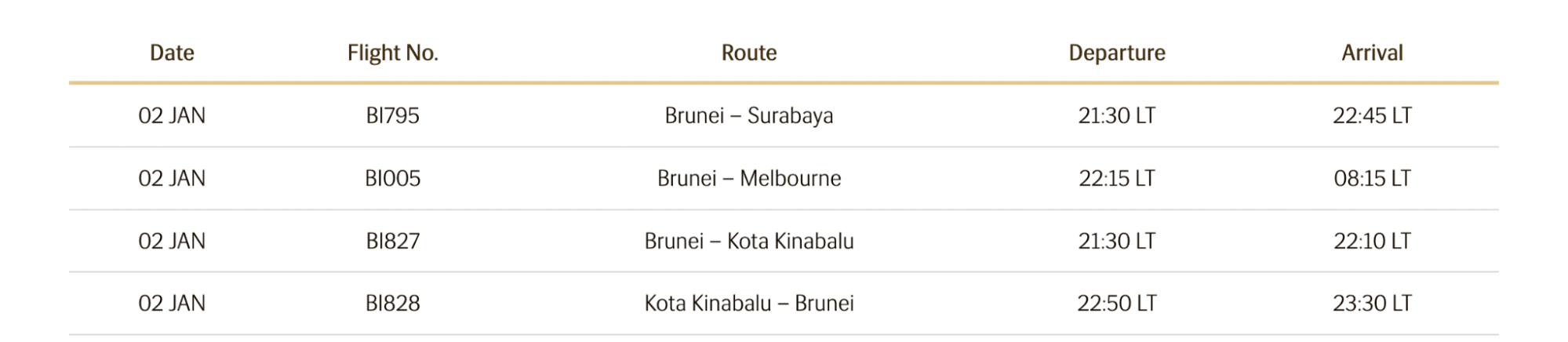
Royal Brunei Airlines has reported delays on a number of flights scheduled for 2 January 2026. Updated departure and arrival times have been released for services BI795 between Brunei and Surabaya, BI005 on the Brunei–Melbourne route, BI827 operating to Kota Kinabalu, as well as the return flight BI828. The airline said the changes were made while prioritising standard operational safety procedures.
The carrier confirmed that revised schedules were published to allow passengers to review their travel plans. An apology was issued to customers affected by the changes, with travellers advised to check flight times before heading to the airport. The delays may influence connecting journeys, airport transfers or pre-arranged plans at destination airports, particularly during a period of higher-than-usual regional travel demand.
Royal Brunei Airlines noted that its 24-hour Customer Service Centre remains available for passengers seeking further information. Support can be accessed by telephone +6732212222 or via WhatsApp +6738383111, where travellers can confirm updated timings or discuss booking-related questions. No specific reason for the delays was outlined in the update, with the airline focusing instead on providing revised operational information.
The delayed services continue to run on routes with consistent passenger demand. Flights to Surabaya and Kota Kinabalu continue to support regular short-haul travel within Southeast Asia. The Melbourne service mainly carries long-haul passengers returning for work, study, or scheduled travel after the holiday period. Each route also feeds into wider airport networks, offering onward domestic and international connections.

The update shows how airlines adjust schedules during the early January travel rush. When changes are made at short notice, timely information and access to customer support matter most to passengers. With revised departure and arrival times already published, regular flight checks and extra time for connections or fixed onward plans can help avoid further disruption.